You have 0 items in your cart

15
Sep
Why We Recommend Higher Viscosity Oils for Tuned JLR Engines
Why We Recommend Higher Viscosity Oils for Tuned JLR Engines
We get this question every week and there has been quite a bit of discussion about whether a tuned supercharged JLR engine should continue running the factory recommended 0W20 oil, or whether there is a benefit to moving to something like a 0W30, 0W40, 5W30 or 5W40 based oil.
Our position is that for a tuned engine, particularly one producing substantially more power and torque than stock, there is a legitimate technical reason to consider a higher-viscosity, high-HTHS oil. You are looking for the right balance between cold-start performance, oil flow, timing chain tensioner and rod bearing protection and most importantly, lubrication margin when the engine is being pushed hard.
PLEASE NOTE: It is strongly recommended to allow the engine time to warm up to operating temperature before driving, especially on a tuned calibration.
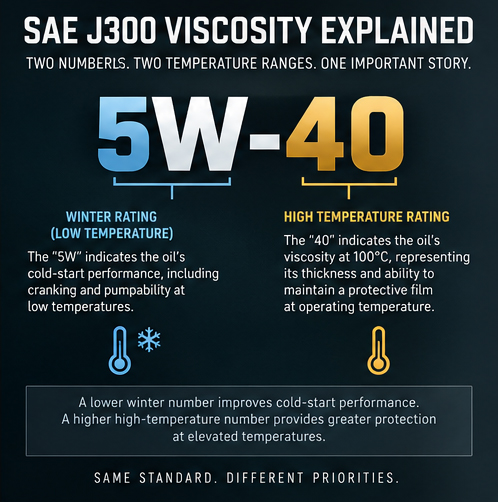
The important number is not just 0W20 or 5W40. The SAE viscosity designation describes two different characteristics.
- The “0W” portion relates to low-temperature performance.
- The “20” portion describes the oil’s high-temperature viscosity classification.
- Therefore, 0W20 is not simply “thin oil,” and 5W40 is not simply “thick oil.”
- A modern 5W40 can still provide excellent cold-start performance while maintaining substantially greater viscosity at elevated operating temperatures.
For a performance engine, what happens when the oil is hot is often considerably more important than the number printed on the front of the bottle.
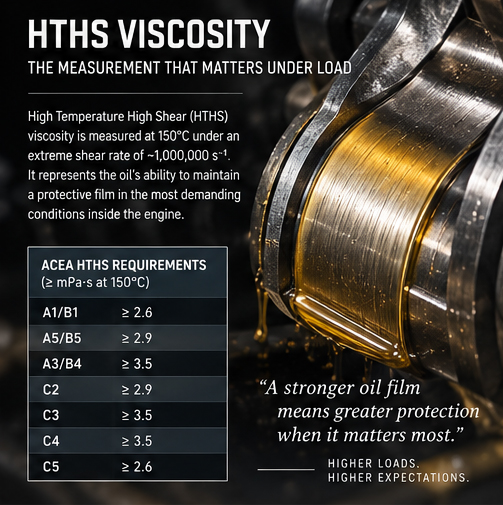
HTHS viscosity considerations
HTHS means High Temperature High Shear viscosity. ACEA measures HTHS viscosity at 150°C under an extremely high shear rate of approximately 1 million reciprocal seconds. Inside the engine, the lubricant is exposed to extremely high shear rates, high temperatures, small clearances and significant mechanical loads. This is particularly relevant to crankshaft and connecting rod bearings.
The crankshaft does not normally ride directly against the bearing surface. It is separated by a hydrodynamic oil film created as the crankshaft rotates through the bearing clearance.
That film has to support the applied load. As oil temperature increases, viscosity decreases. At the same time, a tuned engine can produce substantially greater cylinder pressure and crankshaft loading. That combination is why HTHS viscosity deserves more attention when selecting oil for a modified engine.
What changes when the engine is tuned?
A tuned supercharged engine is not operating under exactly the same conditions as the stock engine. More boost and more power mean more cylinder pressure and greater mechanical loading. That increased load is transmitted through the pistons, connecting rods, crankshaft and bearings.
The engine is also generating more heat. The lubricant therefore has to deal with, higher bearing loads, higher cylinder pressures, higher oil temperatures, increased shear and greater oxidation.
None of this means that 0W20 suddenly becomes a “bad” oil. It means that the engine’s lubrication requirements have changed.
“But the bearings are designed for thin oil”
This is probably the most common argument against higher-viscosity oil. It is also an oversimplification. Yes, bearing clearance matters. But bearing lubrication is not determined by clearance alone. Oil film behavior depends on the relationship between bearing clearance, oil viscosity, oil temperature, engine load and oil supply
A thinner oil can flow more easily through a bearing clearance. That does not automatically mean it provides the greatest protection under high-temperature, high-load conditions.
Likewise, excessively thick oil can create its own problems, including increased pumping losses, drag and cold-start resistance. The goal is not to run the thickest oil possible. The goal is to have sufficient viscosity and HTHS margin for the actual operating conditions.

What about the timing chain concerns on JLR engines?
Timing chain wear is another reason lubricant selection deserves careful attention on these engines. There is a documented history of timing chain and tensioner concerns, which is reflected in modern oil specifications. API (American Petroleum Institute) and current ILSAC specifications include dedicated timing chain wear protection requirements, along with requirements for oxidation control, deposit prevention, and overall engine protection. This is especially important because the timing system is subjected to high engine speeds, repeated acceleration and deceleration, oil temperature, and lubricant shear. API SP introduced a timing chain wear requirement, and API SQ continues that focus with the current specification.
However, while current JLR specifications take timing chain wear into consideration, none of the current JLR specifications take tuning into the equation. Tuning increases RPM and overall thermal load beyond the original calibration, placing additional demands on the timing system that the factory oil specification does not specifically address. Our own proprietary data logging suite has consistently shown the benefits from using an oil outside of the 0W20 JLR specification meant for a stock vehicle.
Therefore, the complete oil formulation matters. The important point is that viscosity, HTHS characteristics, additive chemistry and the oil’s demonstrated performance specification should all be considered together, not just based on a specification alone.
Why ACEA specifications matter
This is where the difference between modern oil classifications becomes important.
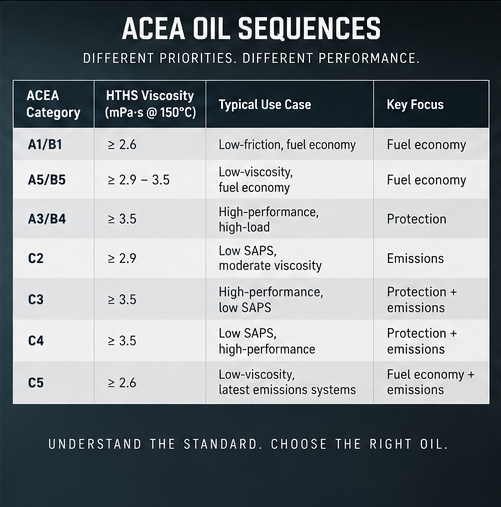
For example, ACEA A3/B4 requires an HTHS viscosity of at least 3.5 mPa·s. ACEA A5/B5 has a lower HTHS requirement, between 2.9 and 3.5 mPa·s, because it is designed around lower-viscosity, fuel-economy-oriented applications. That difference is intentional.
- Lower HTHS viscosity generally reduces friction and can improve fuel economy.
- Higher HTHS viscosity provides greater resistance to flow under high-temperature, high-shear conditions.
- Neither is inherently “better.”
- They are designed around different priorities.
- For a stock vehicle, reducing friction and maximizing fuel economy can be a very reasonable engineering objective.
- For a tuned, high-output supercharged engine, we are more interested in increasing the lubrication margin under high-load conditions.
What about fuel economy?
There is a legitimate fuel economy benefit to lower-viscosity oil.
We aren’t disputing that. Manufacturers use oils such as 0W20 specifically because reducing internal friction can improve fuel economy and help meet increasingly demanding emissions requirements. But tuning an engine is already a decision to prioritize performance over maximum efficiency.
If the engine is producing significantly more power and torque, we don’t see much value in optimizing the lubricant around the last fraction of fuel economy at the expense of additional high-temperature lubrication margin. For a performance application, that is a reasonable tradeoff.
Why 0W30, 5W30 or even 0W40, 5W40?
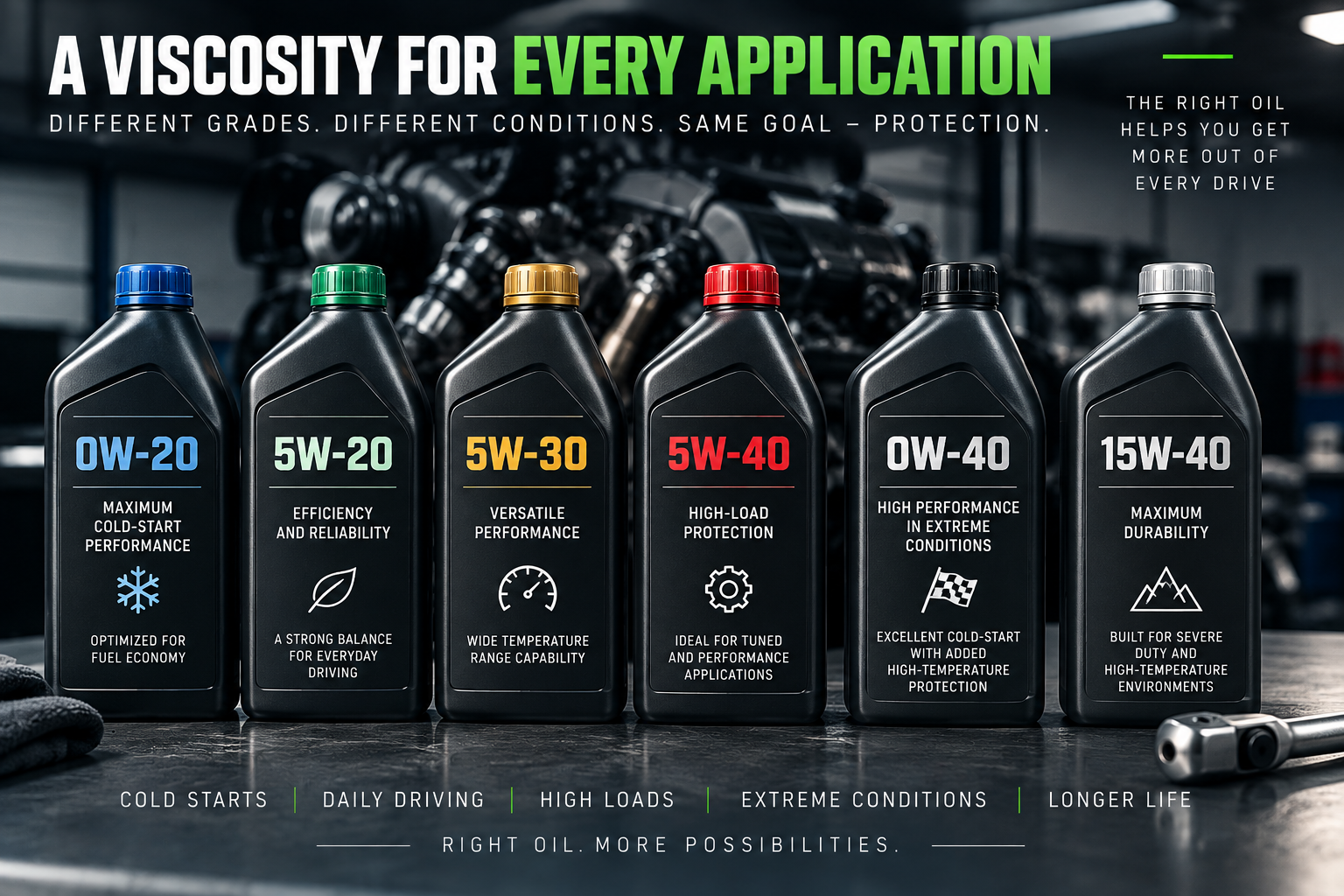
For many tuned street applications, we believe a quality 0W30, 5W30 or 0W/40, 5W40 represents a very good compromise. Compared with 0W20, it can provide:
- Greater high-temperature viscosity
- Higher HTHS viscosity
- Additional protection margin under high load
- Strong thermal stability
- Excellent cold-start performance within its intended temperature range
That doesn’t mean every engine should run these oils. A vehicle used extensively on track may justify a different approach. A tuned engine with a ported or upgraded supercharger may require different application versus a stage 3 tuned engine with just an upper and lower pulley installed. One size does not fit all.
Climate, oil temperature, engine condition, calibration, cooling system configuration and intended use all matter. A vehicle operated in extremely cold temperatures may benefit from a different winter viscosity as another example.
The important distinction
We are not saying: “0W20 will destroy your engine.”
We are also not saying: “5W30 / 5W40 is automatically better than every 0W20.”
What we are saying is that once an engine has been tuned for substantially greater power and torque, it makes sense to reconsider the lubricant based on the engine’s new operating conditions. We prefer to have additional high-temperature and high-shear viscosity margin rather than optimizing exclusively for fuel economy. Our own data logging suite has shown tuning benefits that come from running these oils as well.
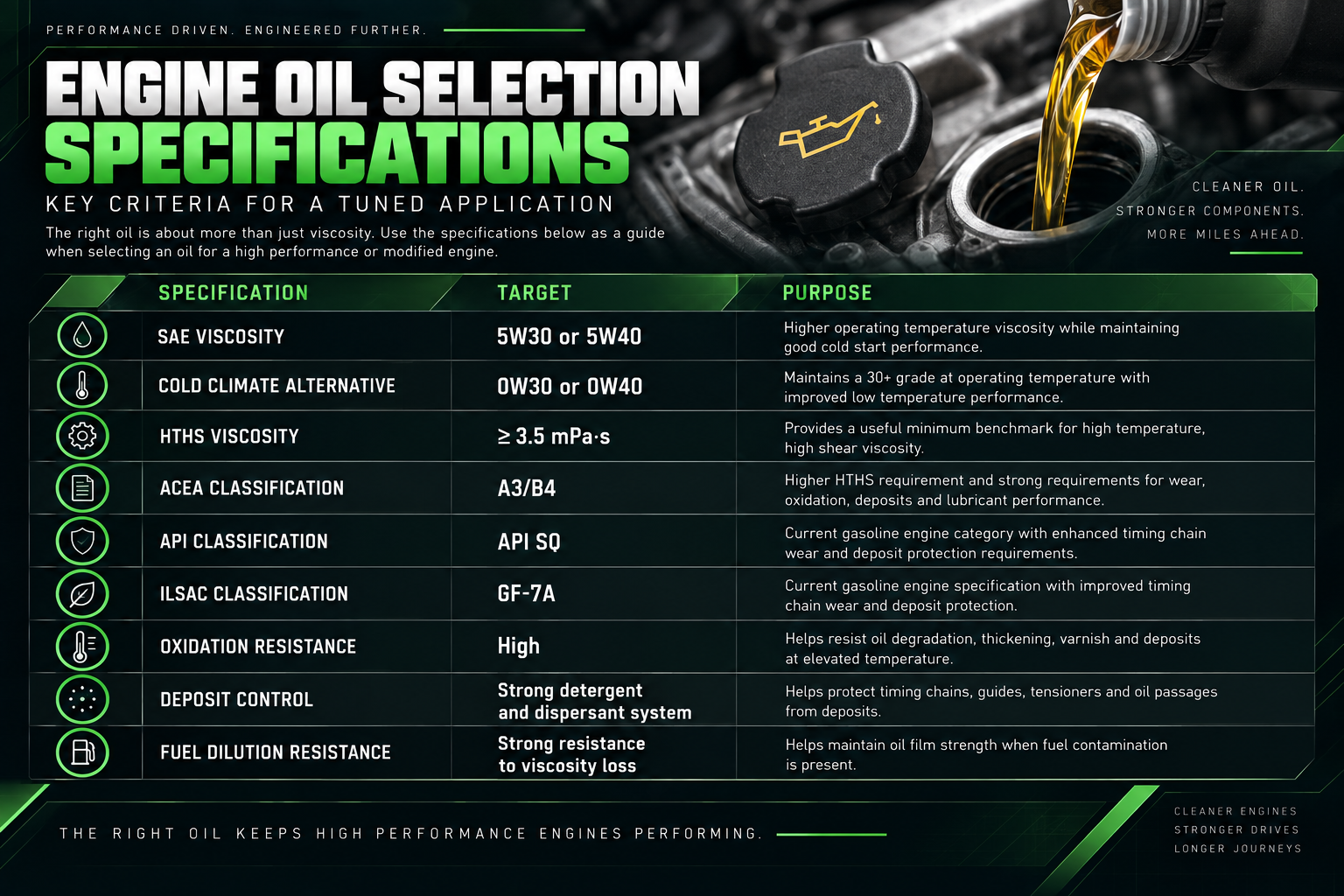
For many applications, a premium oil with an HTHS viscosity of approximately 3.5 mPa·s or greater is a sensible starting point. The exact oil should still be selected based on the vehicle’s modifications, climate, operating conditions and complete lubricant specification, not simply the viscosity printed on the bottle.
Bottom line
The best way to think about this is simple:
- A stock engine and a tuned engine do not necessarily have the same lubrication requirements.
- Other modifications (i.e. ported/upgraded supercharger) need to be taken into consideration.
- More boost means more cylinder pressure.
- More power means more mechanical load.
- More load and temperature place greater demands on the oil film.
HTHS viscosity is one of the most useful measurements for understanding how an oil behaves under those high-temperature, high-shear conditions.
For that reason, we recommend considering a quality higher-viscosity, high-HTHS lubricant for tuned applications. Our position is that for a tuned engine, particularly one producing substantially more power and torque than stock, there is a legitimate technical reason to consider a higher-viscosity, high-HTHS oil. You are looking for the right balance between cold-start performance, oil flow, timing chain tensioner and rod bearing protection and most importantly, lubrication margin when the engine is being pushed hard.
So then which specific oil do you actually recommend?
For our tuned engines, we place considerably more emphasis on the complete lubricant specification and formulation. High quality products from manufacturers such as Red Line, AMSOIL, Motul, and Liqui Moly are examples of oils worth considering, provided the product meets the requirements appropriate for the environment and style in which the vehicle is driven. There are other reputable brands as well. Here is a generic overview to help you decide:
Notes from our Technical Director
One of the primary reasons manufacturers select thinner oils is the balance between cold temperature performance, operating temperature viscosity, film strength, and long-term oil stability. The wider the viscosity spread between cold and operating temperatures, the more susceptible the oil can be to degradation from fuel dilution and other contaminants.
For example, comparing the same brand and formulation, a 0W40 would generally degrade sooner than a 0W20 when exposed to fuel dilution. Likewise, a 0W20 may degrade somewhat faster than a 5W20, although the difference is likely much smaller. This is also why heavier oils such as 15W40 can offer better resistance to fuel dilution than 0W40 or 5W40, but they are too viscous for cold climates to be practical as a year-round oil.
Manufacturers therefore must select an oil that provides adequate film strength at expected operating temperatures, performs across the required climate range, and remains stable for the entire service interval. If a 0W40 degraded by month eight while a 0W20 remained within specification for twelve months, and the 0W20 still provided adequate protection at operating temperature, the 0W20 would make more sense for a 12-month service interval. This is why the move toward thinner oils is not simply about reducing friction and improving fuel economy or emissions. It also allows manufacturers to meet increasingly long service intervals while minimizing maintenance costs, particularly when they include free servicing.
The GM L87 issue is a good example. GM is recalling these engines, and one part of the remedy is moving away from the factory specified 0W20 to a 0W40 oil. That illustrates the tradeoff clearly, thinner oil can provide efficiency and long service intervals, but under certain operating conditions, a heavier oil may provide greater durability and resistance to degradation.
– Chris Edgett, Technical Director at VelocityAP (15 Year Master Technician and 2014 & 2015 Champion of the America’s for Aston Martin)
Technical References:
- SAE J300, Engine Oil Viscosity Classification
- ACEA Oil Sequences, Light Duty Engines
- API Engine Oil Categories
- Lubrizol, ACEA Oil Specification and HTHS Technical Data
- Shell Lubricants, HTHS Viscosity and Engine Oil Technical Literature